
Timber Restoration Services
FiRP® panels, Retroshear®, Retroten®, and Retrocom® reinforcement, Structurfill® and Retrobond® epoxy, and RetroWrap® fiber wrap, our proprietary patented systems, engineered to strengthen existing timber in place without replacing the structure that’s already standing.
Our reinforcement systems aren’t licensed from anyone, they are the founder’s own proprietary IP, developed and proven on heavy timber structures in the field. That ownership is why we can guarantee the engineering behind them.
The result is measurable: design stiffness raised 50–100%, hidden decay detected before it becomes failure, and original timber kept in service for decades longer.
Increase in design strength and stiffness achieved by the FiRP® panel family.
Patents behind our reinforcement systems.
Reads internal timber condition without cutting into the structure, locating decay before it reaches the surface, so every reinforcement that follows is placed exactly where the structure needs it.
Our award-winning reinforcement panel, a thin 1.8 mm laminate of carbon, aramid, and glass fiber bonded to a member to raise its designed strength and stiffness 50–100%. Retroten® and Retroshear® are its two panel configurations.
The FiRP® configuration for shear. Installed where delamination or shear failure has set in, it restores full load on aged spans in place, no tear-out, no replacement.
The FiRP® configuration for the tension face. Bonded along girders and beams, it restores bending and tension capacity to members that have lost it, engineered to a 100+ year design life.
The FiRP® configuration in the same high-strength-fiber panel family as Retroshear® and Retroten®, bonded to existing timber in place to raise strength and stiffness by 50–100% or more.
Our proprietary high-strength two-part epoxy, injected into large voids and cavities, the in-situ log girders and corbels, to fill voids and restore stiffness where a member is hollowed out.
Low-viscosity, high-strength epoxy injected into shear cracks and smaller voids, the fine-detail counterpart to Structurfill®, which fills the large voids and cavities.
Reinforced polymer fiber wrap, applied in place around piles and exposed members to restore or increase load-bearing capacity, the core of our in-situ bridge and marine repairs.
Load-path analysis, moisture mapping, and decay detection testing establish exactly what the structure can carry today.
Our engineers specify the FiRP® configuration, Retroshear®, Retroten®, or Retrocom® panels, plus Structurfill® or Retrobond® epoxy, or RetroWrap® fiber wrap where the member needs it, to hit your target capacity and design life.
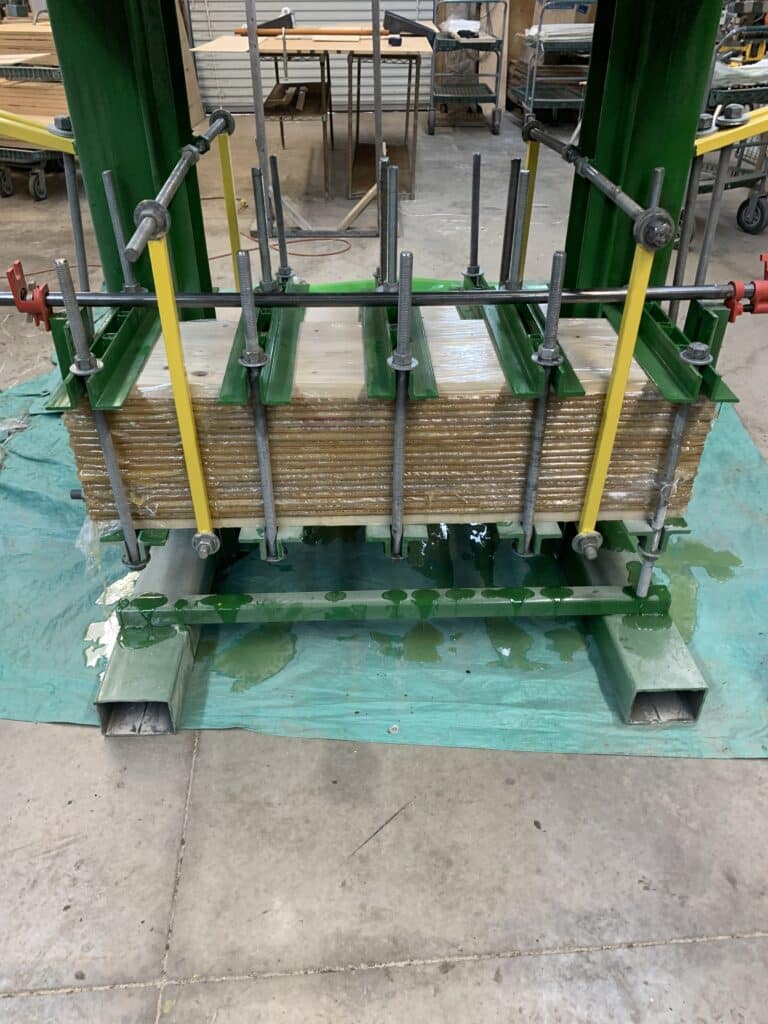
Reinforcement components are fabricated and pre-fit in our climate-controlled facility, then load-tested before they ship.
Crews install in place with minimal disruption, the structure stays standing, and the original timber stays in service.
Our patented reinforcement systems are applied in place, wherever the structure stands, with reach across 55 countries and six continents, from our three home offices.
FiRP® panels and epoxy systems ship from our facilities and our technicians install them on site. Distance changes the freight, not the engineering.
Yes — that is the entire point of our FiRP® reinforcement panels. We add capacity to the timber that’s already in place, keeping the original structure standing and in service. Replacement is the last resort, not the default.
Our FiRP® panels — the Retroshear® panel for shear, the Retroten® panel for tension, and the Retrocom® panel for compression — typically raise design stiffness by 50–100%, depending on the member and the loading target. Every figure is established by engineering analysis specific to your structure.
Decay detection testing is built to find it. We detect internal decay before it becomes a failure point, then design the reinforcement around what the structure can actually carry — so you’re not strengthening rotten timber or missing a weak member.
It’s ours. The systems are covered by 40+ patents TRS is licensed to use. That ownership is why we can stand behind the engineering and why you can’t get these exact systems anywhere else.
Wherever possible, reinforcement components are fabricated and pre-fit in our climate-controlled facility and load-tested before shipping. That means faster, lower-risk installation with fewer surprises in the field.
We use cookies to improve your experience on this website. You may choose which types of cookies to allow and change your preferences at any time. Disabling cookies may impact your experience on this website. You can learn more by viewing our Cookie Policy.
