
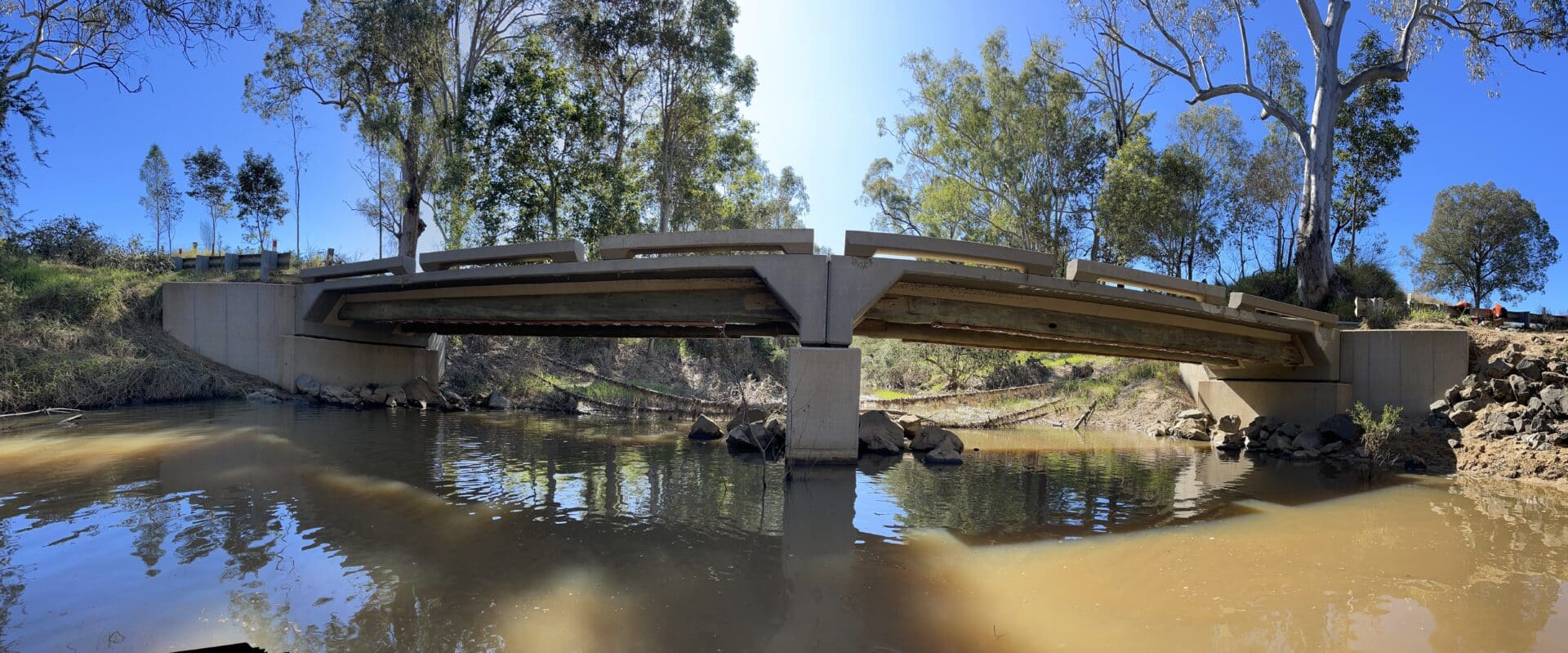
When an inspection report says a bridge has reached the end of its serviceable life, most councils start budgeting for replacement. That is the expensive answer, and it is often the wrong one.
Somerset Regional Council had 21 Doolan Deck bridges showing deteriorating concrete decks, notch splits, and separation between deck and girder. Instead of replacing them, TRS rehabilitated all 21 across two programs. The final 17 were completed in six weeks, under traffic, for less than $1.5 million, and came back with their Condition State Rating restored and 60+ years added to their service life.
Here is how, and why the failures happened in the first place.
What the Doolan Deck system is
Modular bridging systems became popular in the early 1990s, starting with the Doolan Deck system used to repair the Buccarumbi Bridge over the Nymboida River in northern New South Wales. Across Queensland and New South Wales, the system spread quickly as a cost-effective approach to both repair and new bridge construction. It was named after Terry Doolan, the architect and engineer behind it.
The system pairs Durability Class 1 hardwood log girders, preferably de-sapped and low shrinkage, with a reinforced concrete deck. The deck integrates to the girders through vertical fasteners and steel plates drilled and recessed into the planed top surface of the log girder.
The engineering concept was sound on paper: use the compression strength of concrete alongside the tensile capacity of the hardwood log girder, with an interfacial shear connection that allows plane sections to remain plane. The superstructure was prefabricated in yards and transported to site, which cut road closure time. Many of these modular systems were designed for T44 traffic loads.
Why the system fails over time
The system was hailed as a game changer. What it did not account for was timber behavior, and those gaps have surfaced after years in service.
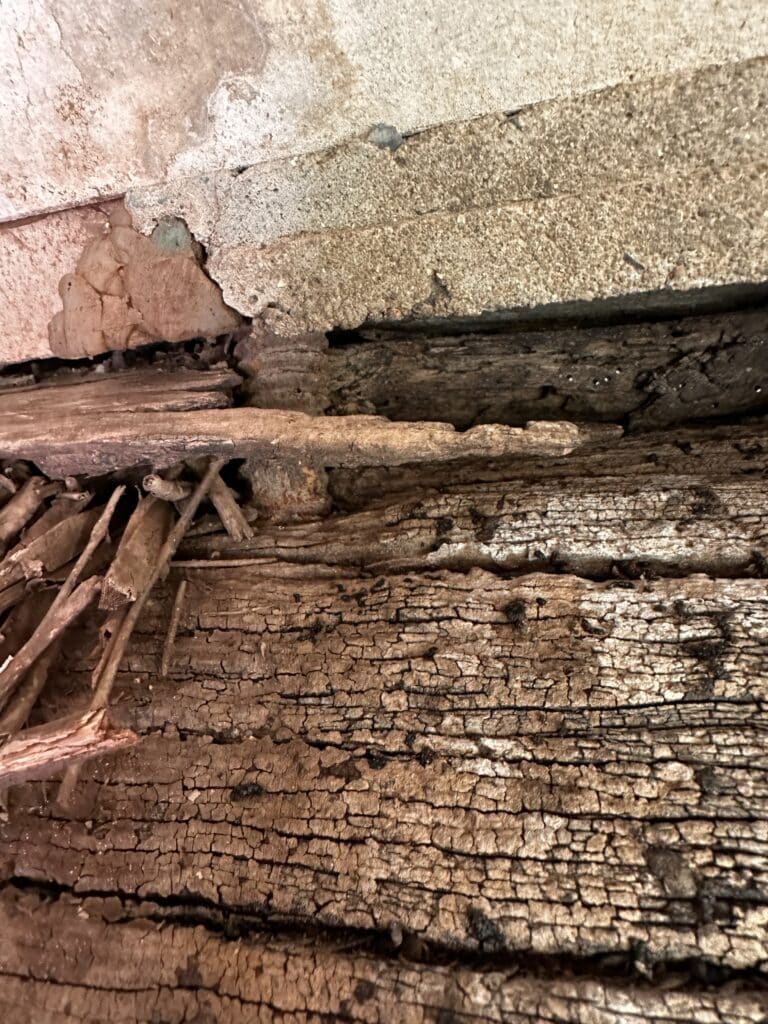
Over time the concrete deck cracks. Moisture moves through those cracks and reaches the timber, creating a decay zone at the concrete and timber interface. Moisture barriers make it worse rather than better, because the vertical fasteners penetrate the barrier and carry moisture through to the top of the log girder, where it becomes trapped.
The top half of the log girders then decays from elevated moisture content above 24%. That reduces the modulus of elasticity in compression parallel to grain, which reduces the design composite stiffness of the system. Lower composite stiffness means excessive deflection in the deck and girder system, which cracks the concrete deck further, which admits more water. The cycle degrades both stiffness and bending strength.
Concrete encasement of the girder ends compounds the problem by trapping moisture in the end grain. And because neither the girder ends nor the top surface are accessible, this degradation is easy to miss entirely during a standard inspection.
Good timber design keeps air circulating around timber elements so relative moisture content stays low. Fungal decay activates above 24% moisture content. Concrete decks and concrete encapsulation do the opposite: they admit moisture and eliminate the air circulation that would otherwise keep it in check.
The Somerset Regional Council project
Where councils had been told after inspection that their bridges had reached the end of serviceable life, the successful rehabilitation of four earlier Doolan Deck bridges offered a different option within Somerset Regional Council’s 2022 budget.
With 17 more Doolan Deck bridges showing deteriorating concrete decks, notch splits, and deck to girder separation, the council engaged Timber Restoration Services to rehabilitate the concrete decks and timber girders at substantially lower cost than replacing them.
Four problems needed to be solved to restore structural integrity and long-term durability:
- Concrete attenuation to moisture ingress
- Decay at the concrete and timber interface, and at girder ends
- Notch splits
- In situ strengthening where log girders had separated from the concrete decking
Sealing the concrete against moisture ingress
Exposed to movement and weather, the concrete decks had cracked throughout. Those cracks let moisture permeate the deck and settle against the top of the girder, creating the decay zone.
Rather than seal the decks and joints with asphalt or a surface sealer, TRS engaged Markham Global to apply Aquron 7000, a penetrative treatment that reduces the permeability of the concrete while maintaining skid resistance. A penetrative system avoids the core problem with surface sealants, which degrade over time under traffic, sun, and movement, and then admit moisture again.
Aquron 7000 treatment met every requirement the protection system had to satisfy:
- Prevents moisture ingress into the concrete
- Reduces concrete permeability
- Penetrates deeply rather than sitting on the surface
- Seals cracks up to 0.5mm and is not compromised by future micro-cracking
- Remains flexible under structural movement
- Maintains skid resistance
- Cures quickly, minimising traffic disruption
- Environmentally friendly
Combined with girder rehabilitation, this restored structural capacity and protected the longevity of the superstructure.
Arresting decay at the interface and girder ends
Where timber sits in hard contact with concrete, the goal is to shut down fungal decay by reducing moisture content in that zone. Fungal growth needs moisture content above 24% to sustain decay activity. Reduce the moisture, reduce the decay.
When timber is encapsulated or held hard against concrete with no air movement, fungal decay follows. The difficulty with Doolan Deck bridges is that the decay zones are both invisible and inaccessible. The same problem occurs when timber poles are encased in concrete sleeves: the damage is real and you cannot see it.
These bridges had two primary decay zones, the top surface cut and the girder end, and neither could be reached. TRS installed Decaystop® diffuser rods to counter the fungal activity.
Fungi feed on wood by secreting an acidic wave at the leading edge of the colony. The salt borate in a Decaystop® diffuser rod neutralises that acidic wave, which stops the feeding activity and arrests the progression of decay. The diffuser rods activate when moisture content in the surrounding timber rises above 20%.
For the council maintenance crew this is straightforward to manage. The diffuser rods can be checked as part of the normal bridge maintenance cycle, or after significant rain or flooding, to see whether they have depleted. Replacing them means unscrewing a bung and inserting a new rod.
Correcting notch splits
The common slope cut ratio found on timber bridges is 1:4. The Timber Bridge Maintenance Manual recommends a 1:4 snipe slope, but across years of attending to damaged bridges built to that ratio, TRS has found that a 1:6 ratio mitigates splitting.
The notch split is caused by a rapid change in stiffness at the squared or 1:4 slope cut. That rapid change induces tension forces perpendicular to the grain, which is timber’s weakest direction, separating the bottom portion from the top along the line of change. A more gradual 1:6 slope, finished with Anchorseal® sealer on the fresh cut surface, reduces both the tension forces and the moisture egress that drive the split.
Anchorseal® sealer is a paraffin wax in water solution that slows the rate of moisture loss from timber surfaces. Applied to end grain exposed by the 1:6 cut, it slows end grain moisture travel to roughly match side grain, which reduces end checking in that zone. End checking occurs precisely because of that differential in moisture travel.
Where the split is too long or too large to resolve with a new slope cut, the girder strengthening method in the Timber Bridge Maintenance Manual does not stop or slow the split, because it does not reduce the tension forces perpendicular to the grain. In practice it causes more cleavage and grain separation, frequently ending in four separate sections in the log girder end. It is a poor detail.
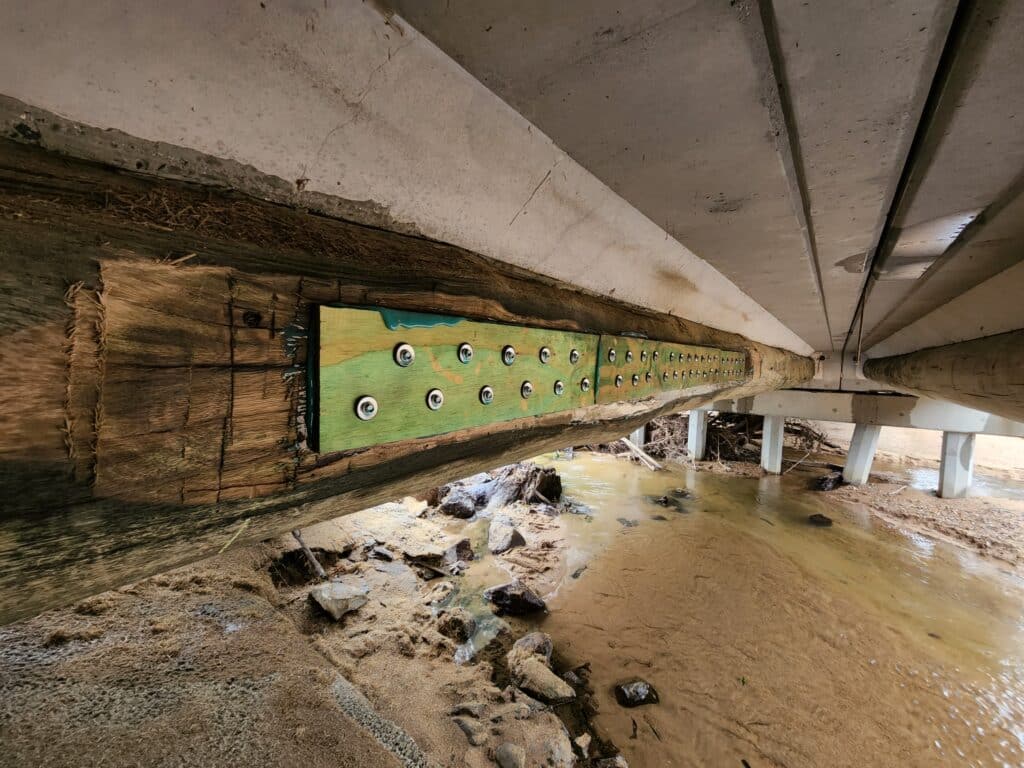
The approach TRS has developed over decades is to remove the separated piece using a 1:6 slope cut, reducing the rapid change in stiffness, then install a Retroten® laminate to the underside to strengthen the reduced depth extension. The solution is designed and engineered by Wood Research and Development.
Strengthening girders in situ
Shrinkage and moisture-driven decay had, in places, separated the log girder from the concrete deck, producing discrete cracking in the concrete.
The original design assumed that engaging the concrete deck to the timber girder would restrain the top of the girder, forcing it to shrink upward from the headstock. That is not how timber behaves. Timber shrinks with the grain, and for log girders the shrinkage pattern is radial, from outside to inside. Because the pattern runs outside to inside, the girder centroid stays where it is.
The concrete was not flexible enough to follow that shrinkage pattern, so the top log surface pulled away from the concrete underside. The resulting gaps caused shear translation and bearing issues. The bearing issues were the more serious of the two, because the gaps gave the concrete deck room to flex downward under its own dead load and under traffic, cracking the concrete further.
After the girders across all 17 bridges were treated with diffuser rods, TRS performed a Level 1 inspection focused on girder defects that could affect long-term structural performance, including stress checks rather than shrinkage checks, sloping grain, and significant knots. Following engineering analysis and instructions from Wood Research and Development, TRS applied a Retroten® laminate to the underside of the log girders to reinforce structural capacity.
Retroten® laminate is a polymer aramid composite fibre bonded to the log, creating a structural tension band along the girder underside. For girders carrying inherent defects such as stress checks, it is a fail-safe answer to the risk of bending failure.
The result
Before rehabilitation, the Doolan Deck bridges carried a Condition State Rating of 3, with an initial appraisal of 2 to 15 years at maximum load limit.
After the first four bridges were successfully rehabilitated, Somerset Regional Council was able to fund the rehabilitation of 17 more within the same financial year budget. All 17 now hold a Condition State Rating of 2, with service life extended by another 60+ years given a regular service check regimen.
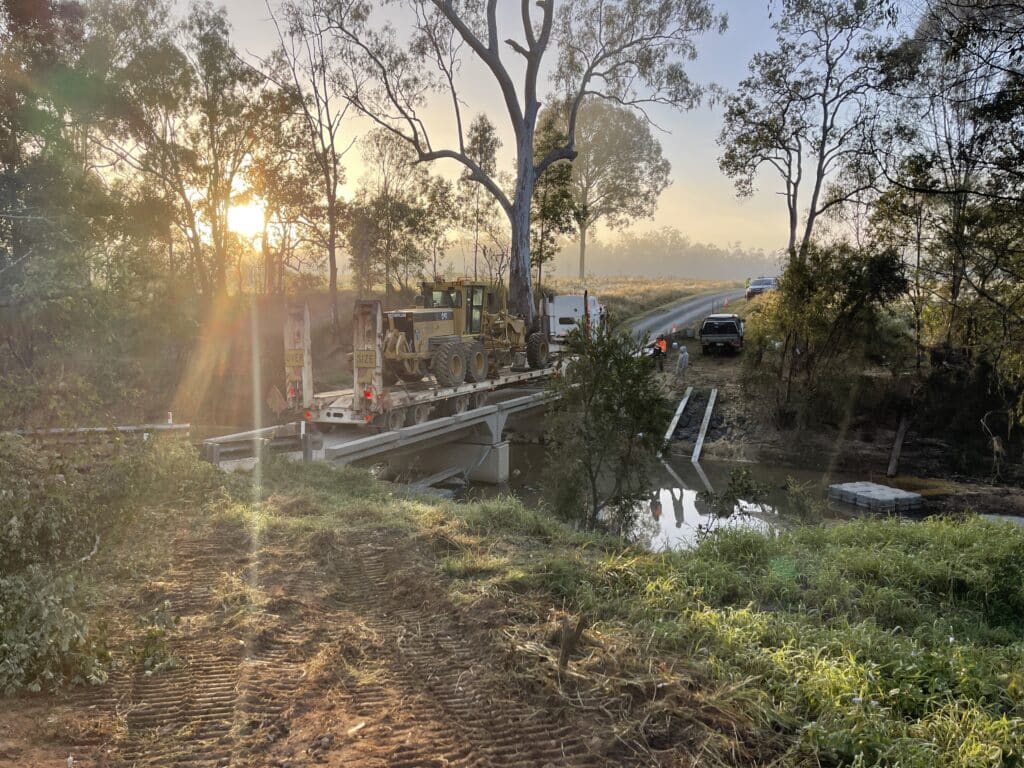
The full program took six weeks, restored the bridges to a Condition State Rating of 2, and raised the load rating to the required level. Rehabilitating the log girders, repairing the concrete decks, and applying Aquron 7000 came in at less than $1.5 million, well below any alternative. All of the work was performed under traffic with minimal disruption to service.
What this means for council asset managers
Replacing concrete-decked timber bridges is drastic, prohibitively expensive, and disruptive to the community. State and federal grants exist, but the requirement for councils to fund roughly half the cost makes bridge replacement a difficult call against a limited budget and a register full of deteriorating assets.
Rehabilitation changes the arithmetic. Somerset Regional Council significantly extended the service life of existing bridge assets at low cost to the asset registry, with small sinking fund requirements. Replacement would have meant enormous capital cost, large long-term sinking fund obligations, and community frustration over extended road closures.
If your inspection reports are telling you a timber bridge has reached the end of its serviceable life, it is worth a second opinion before it goes on the replacement list.
Acknowledgement
Timber Restoration Services and Wood Research and Development thank Somerset Regional Council and Works Co-ordinator Peter Hardie for permission to publish the rehabilitation works performed on the Doolan Deck bridges in the Somerset region.
Reference
Doolan, T.F., Carter, D.J., Roberts, W.S., Taylor, R.J., and Wheen, R.J., “Development of a Timber/Concrete Modular System for Timber Bridge Rehabilitation”, Bridging the Millennia, 1997 Bridge Conference, Sydney, Australia, 3 to 5 December 1997, Conference Proceedings, p. 347 to 348.