
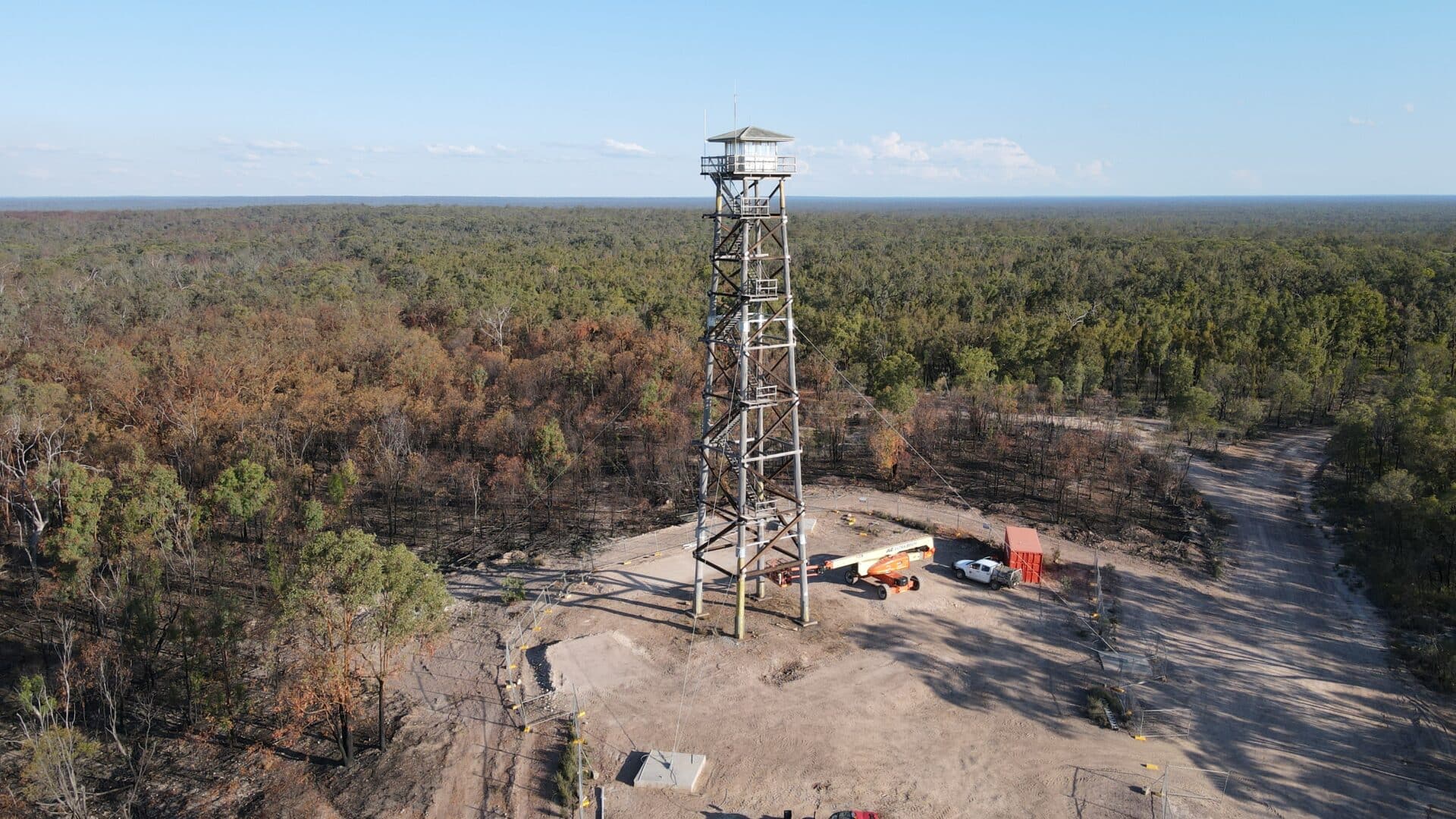
Located north of Miles, within the Barakula State Forest, the Waaje Fire Lookout Tower stands above the treetops. It was built in 1964 to spot a fire from its first smoke, and in January 2018 it was added to the Queensland Heritage Register.
It is a four-legged timber fire tower with a cabin at the top, built from four 30 metre single-length grey ironbark poles. It was the first Queensland fire tower to exceed 30 metres, and it is now the tallest surviving intact four-legged timber fire tower.
TRS was awarded the contract to restore it, not as a monument, but back to working status as an active fire lookout.
The scope of works
Five things had to happen, and every element not on that list had to stay exactly as it was:
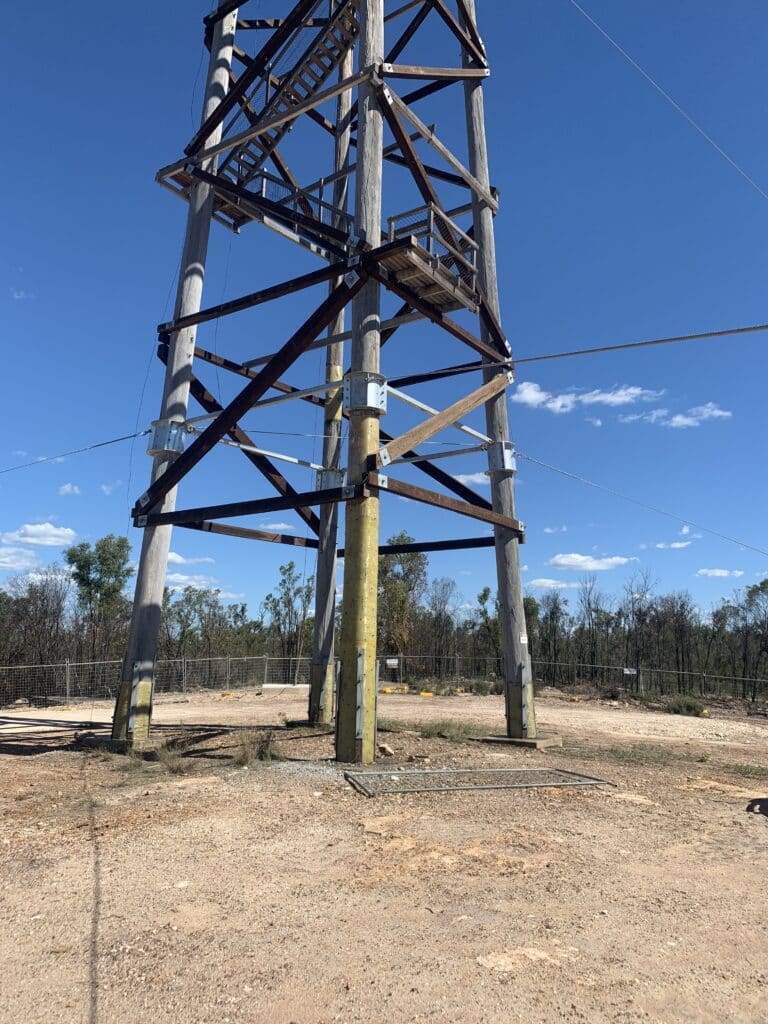
- Repair the tower legs
- Remove the lowest stairwell
- Replace the timber bracing
- Replace broken cabin louvres
- Construct anchor blocks and connect new guywire supports
Working at 30 metres
At 30 plus metres in the air, simple tasks become daunting, particularly with high thermal wind gusts rolling over hot dry forest land.
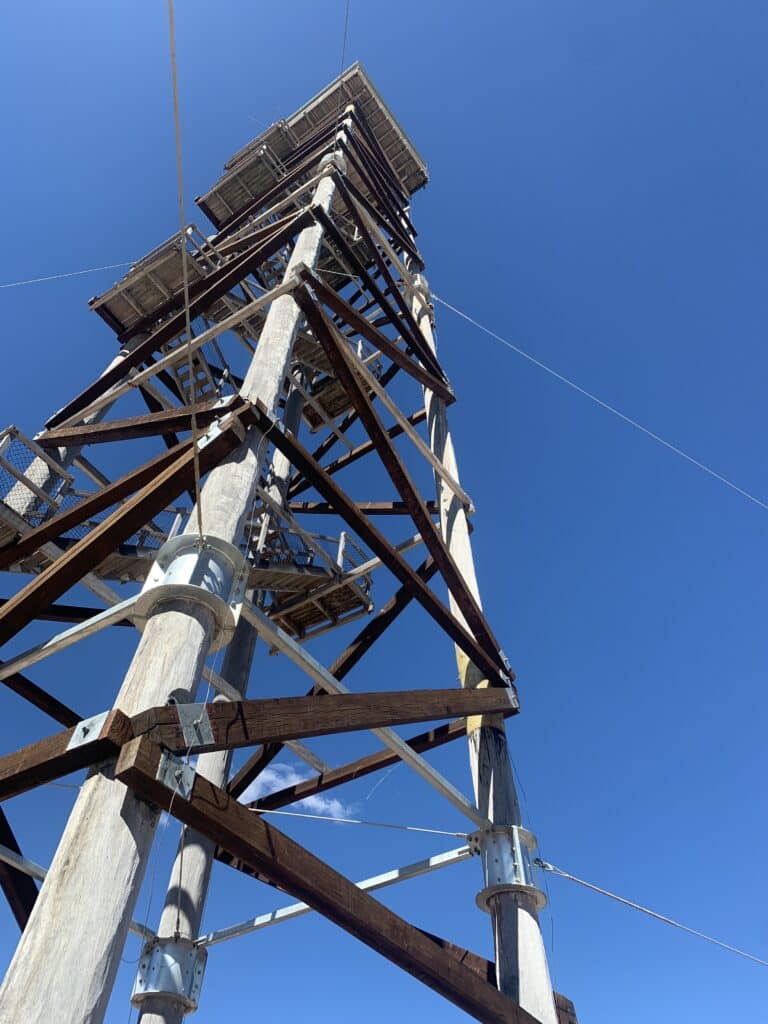
Working from a telescopic boom elevated work platform, the crew repaired the deteriorated sections of the tower legs using high strength fibre wraps, which restored capacity to those sections. Where cavities were found inside the legs, they injected Structurfill® filler, a specialty high strength epoxy formulated for timber, to rebuild the section from within.
To slow future deterioration, the legs were then treated with Decaystop® diffuser rods installed in a spiral configuration around each pole.
The bracing was replaced and augmented from top to bottom with heavier dimensioned timber members, lifted into place using a winch system working alongside the elevated platform.
Anchoring a 30 metre timber tower
Using custom fabricated collars and massive concrete foundation blocks cast in ground, the guywires and support systems were installed and tensioned at their specified positions.
The anchor blocks were set diagonally opposed, in line with each leg. Each block took nearly eleven cubic metres of concrete. In those ambient temperatures, concrete quality becomes a live risk on delivery, so TRS set a hard limit: a maximum of 120 minutes for a truck to be on site, or the load was rejected.
The lookout cabin
After 50 plus years of high winds and storm events, the cabin needed the louvre frames repaired so every louvre returned to a closed position, with new glass louvres installed where required. A closed cabin is a watertight cabin, and a watertight cabin is what protects everything below it.
To keep the cabin intact and restrict future access, the lowest set of stairs, starting at the first lateral tie, was removed.
Finishing before Christmas
The TRS field crew worked through soaring late-year summer heat to bring the project to completion ahead of the 2020 Christmas break.
The view from the worksite made it worthwhile.
What this means for heritage asset owners
Queensland holds a significant number of heritage timber structures, its fire towers among them, and most share the same problem. They are old, exposed, irreplaceable, and standard visual inspection cannot tell you what is happening inside the timber.
The answer is rarely replacement. It is accurate assessment followed by targeted intervention: find the real loss of capacity, restore it, control the loads causing deterioration, and keep water out. Done properly, a structure like this has decades of service ahead of it rather than a demolition date.
The structure standing in Barakula today is the same one raised in 1964. That is the argument for restoration over replacement, made better than any brochure could.
If you hold a heritage timber asset and an inspection report says it has reached the end of its life, that conclusion is worth testing before it becomes a budget line.
Project details
- Client: Queensland Department of Housing and Public Works
- Location: Barakula State Forest, north of Miles, Queensland
- Completed: December 2020
- Structure: Four-legged timber fire tower, built 1964, four 30m single-length grey ironbark poles
- Heritage status: Queensland Heritage Register, listed January 2018
- Service: Heritage restoration
